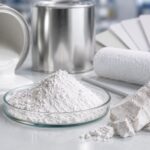
Natural vs coated calcite is one of the most common purchasing decisions a polymer compounder, paint formulator or masterbatch producer faces. Both grades start from the same micronised calcium carbonate, but a surface treatment with stearic acid changes how the filler interacts with the polymer matrix — and therefore the downstream mechanical, optical and processing behaviour.
This guide explains what natural calcite is, how stearic-acid coating is applied, where each form is the correct choice, and how to evaluate coating quality from a supplier’s Certificate of Analysis. The content is written for plastics, paint, masterbatch and cable industry R&D engineers and procurement leads.
Quick definition: Natural calcite is micronised CaCO₃ with no surface treatment — hydrophilic and best in water-borne or polar systems. Coated calcite is the same micronised CaCO₃ whose surface has been treated with stearic acid (typically 1–3 % w/w), producing a hydrophobic filler with excellent dispersion in polyolefin compounds (PP, PE, PVC) and improved flow in plastic and masterbatch extrusion.
What Is Natural Calcite?
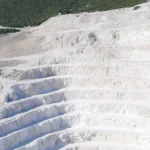
Natural calcite is micronised CaCO₃ extracted from a calcite quarry and ground to a controlled particle-size distribution without any surface treatment. The mineral surface remains hydrophilic — it bonds well with water and polar systems and resists adhesion to non-polar polyolefins.
Key properties of natural calcite:
- Pure CaCO₃ chemistry (typically above 97 %)
- Hydrophilic surface
- High ISO whiteness (90 – 97)
- Excellent in water-borne and polar systems (paint, adhesives, paper coatings)
- Cost-effective and easy to source in bulk
Natural calcite is the standard choice in paint, paper, water-borne adhesives, agricultural liming and many construction-chemicals applications.
What Is Coated Calcite?
Coated calcite is micronised CaCO₃ whose particle surface has been treated with stearic acid (or, less commonly, with calcium stearate or silane). The treatment forms a thin organic monolayer around each particle and changes its surface chemistry from hydrophilic to hydrophobic.
Key benefits of the coating:
- Hydrophobic surface — excellent compatibility with PP, PE, PVC and other polyolefins
- Lower viscosity and easier dispersion in plastic and masterbatch extrusion
- Reduced moisture pickup during storage
- Better mechanical properties (tensile strength, elongation) at high filler loadings
- Reduced extruder torque and screw wear
How Is Stearic Acid Coating Applied?
Stearic acid coating is performed by adding 1–3 % w/w of stearic acid (or its calcium salt) to the micronised calcite in a controlled high-temperature mixing process. The fatty-acid molecule’s polar carboxyl end bonds to the calcite surface, while the long aliphatic tail orients outward, creating a hydrophobic shell.
Common process parameters:
- Process temperature: 100 – 130 °C
- Stearic acid loading: 1 – 3 % w/w
- Residence time in the heated mixer: 5 – 15 minutes
- Quality control: contact angle, ash residue (TGA), free stearic acid content
A properly coated calcite leaves no “free” stearic acid on the surface — the entire fatty acid is chemically bonded to the calcium ions on the particle surface, so the product does not bloom out or migrate during compound storage.
Technical Comparison: Natural vs Coated Calcite
| Property | Natural Calcite | Coated Calcite |
|---|---|---|
| Surface chemistry | Hydrophilic | Hydrophobic (stearic acid layer) |
| Polymer compatibility | Limited in polyolefins | Excellent in PP, PE, PVC |
| Water-borne systems | Excellent | Limited (water repellent) |
| Dispersion in extrusion | Moderate (needs coupling agent) | Excellent (built-in surface compatibility) |
| Compound viscosity | Higher | Lower (better flow) |
| Moisture pickup | Higher | Lower |
| Extruder torque | Higher at high loadings | Lower |
| Mechanical performance | Limited above 30 % loading | Strong even at 60–80 % loading |
| ISO whiteness | 90 – 97 | Slightly lower (88 – 95) |
| Cost | Lower | Slightly higher |
Which Industry Should Choose Which?
Plastics (PP, PE, PVC, ABS) — Coated Calcite
Polyolefin compounders almost universally prefer coated calcite. The stearic acid surface treatment enables higher loadings without sacrificing mechanical performance — critical in PP, PE and PVC compounding.
Masterbatch — Coated Calcite
Filler and colour masterbatches typically carry 60–80 % CaCO₃ loadings. At these levels only coated calcite can be processed without extreme torque, surface roughness or downstream blooming. See our masterbatch range.
Cable (HFFR) — Mostly Natural Calcite
HFFR halogen-free cable compounds typically use natural calcite because the polar polymers (EVA, EBA) and ATH/MDH primary flame retardants already need polar interfacial chemistry. See our HFFR cable guide.
Paint — Natural Calcite
Both water-borne and solvent-borne paints use natural calcite for its hydrophilic surface and high whiteness. See our paint industry portfolio.
Paper — Natural Calcite
Both wet-end filler and surface coating applications use natural calcite. The polar pulp environment requires the hydrophilic mineral surface.
Rubber — Both, Application-Dependent
Natural calcite is used in general-purpose rubber compounds; coated calcite is preferred in high-loading PP/EPDM and polyolefin-rubber alloys. See our rubber industry portfolio.
How Do You Recognise Good Coating Quality?
Coating quality directly drives compound performance. Three indicators on the supplier’s Certificate of Analysis matter most:
- Free stearic acid content — should be below 0.1 % (typically reported by IR or extraction methods). Excess free acid blooms out of the compound and migrates to surfaces.
- Coating coverage — measured via wettability tests; a well-coated calcite repels water and forms a clean meniscus.
- Thermogravimetric analysis (TGA) — quantifies bound stearic acid; well-coated grades show a single, narrow decomposition peak between 300 and 400 °C.
If a supplier cannot supply this data, the coating quality is not validated. Aydın Madencilik ships every coated grade with TGA and IR data attached to the Certificate of Analysis.
Summary: Natural or Coated?
Use natural calcite when the system is polar (water-borne, paint, paper, polar polymers such as EVA, ATH-loaded HFFR cable). Use coated calcite when the system is non-polar (PP, PE, PVC, polyolefin masterbatch) and you need high filler loadings, low compound viscosity and minimal moisture pickup.
Aydın Madencilik produces both natural and stearic-acid-coated grades from its Bursa Gemlik facility. Our coated grades carry the suffix “-K” — for example AY 108-K, AY 210-K. Talk to our technical team for grade selection guidance.
Frequently Asked Questions
Why is calcite coated with stearic acid?
Stearic acid converts the hydrophilic calcite surface into a hydrophobic one. This makes the filler compatible with non-polar polyolefins (PP, PE, PVC), reduces compound viscosity, lowers moisture pickup and enables high filler loadings without sacrificing mechanical performance.
Can natural calcite be used in polyolefins?
It can be, but typically requires the addition of a coupling agent (such as MAH-g-PE) during compounding. For low filler loadings (under 20 %) this is workable. Above 30 %, coated calcite is the practical choice.
Does the stearic acid coating affect colour or whiteness?
Slightly — coated calcite typically shows ISO whiteness 2–3 points below the natural equivalent. In most plastic and masterbatch uses this is not noticeable; for premium white paint and paper, natural calcite is preferred.
Can coated calcite be used in HFFR cable compounds?
It can, but natural calcite is more common in HFFR formulations because the base polymers (EVA, EBA) are polar and ATH/MDH primary flame retardants also work better with polar interfaces. Coated calcite is occasionally used in polyolefin-based LSZH compounds where the polymer is non-polar.
How much more expensive is coated calcite?
Typically 8–15 % more than the equivalent natural grade. The premium is repaid by lower extruder torque, higher productivity, lower coupling-agent requirement and improved mechanical performance — usually generating net savings in high-loading compounds.
Are there alternatives to stearic acid coating?
Yes. Calcium stearate (the salt of stearic acid) gives similar compatibilisation. Silane-coupling agents (e.g. amino-silanes) deliver stronger covalent bonding for specific applications. Polymer-grafted coatings (PE-g-MAH) are used in advanced engineering plastics. Aydın Madencilik can supply custom-coated grades on request.
Match the Coating to the Formulation
The natural vs coated calcite choice is not about quality — it is about matching the surface chemistry of the filler to the polarity of your polymer system. The right grade pays back in productivity, mechanical performance and shelf life.
Request a sample and ask for the matching grade for your formulation: Request a sample | Browse our calcium carbonate range