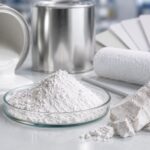
Calcite vs kaolin is a comparison manufacturers often face when choosing a filler and pigment extender. Both are white, soft industrial minerals, yet chemically they are completely different: calcite is calcium carbonate (CaCO₃), while kaolin (china clay) is a hydrous aluminium silicate — Al₂Si₂O₅(OH)₄. This difference drives acid behaviour, pH, oil absorption and application preference.
This guide covers the chemical and physical differences between calcite and kaolin, the distinction between hydrous and calcined kaolin, why each is preferred in paper, paint, plastics and ceramics, and how to choose the right one. It is written for filler buyers, paint and paper R&D engineers, and quality-control teams.
Quick answer: Calcite vs kaolin starts with chemistry. Calcite is CaCO₃; kaolin is Al₂Si₂O₅(OH)₄. Calcite is alkaline (pH ~9) and fizzes with acid; kaolin is neutral-to-slightly-acidic and does not react with acid. Kaolin is platy with higher oil absorption; calcite is blocky with low oil absorption and lower cost. Calcite is used for cost/brightness, kaolin for opacity, matting and ceramic bodies.
Calcite and Kaolin: Basic Definitions
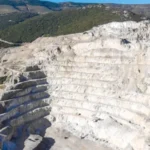
Calcite is the most common crystalline form of calcium carbonate (CaCO₃) and the main component of limestone and marble. For its general properties, see our what is calcite guide.
Kaolin is a clay made up mainly of the mineral kaolinite; it is a hydrous aluminium silicate. It is used in two basic forms:
- Hydrous (natural) kaolin: ground and refined; platy, white and relatively low in abrasiveness.
- Calcined kaolin: heat-treated at ~650-1000 °C to remove water; higher opacity, brightness and oil absorption, but more abrasive. Used as a titanium dioxide extender in paint.
The origin difference between calcite and kaolin is the basis of every practical distinction: carbonate chemistry versus aluminosilicate chemistry changes everything from acid reaction to pH and optical behaviour.
Calcite vs Kaolin Comparison Table
| Property | Calcite | Kaolin |
|---|---|---|
| Chemical formula | CaCO₃ | Al₂Si₂O₅(OH)₄ |
| Mineral class | Carbonate | Aluminosilicate (clay) |
| Mohs hardness | 3 | 2 – 2.5 |
| Specific gravity | 2.71 g/cm³ | ~2.6 g/cm³ |
| Particle morphology | Blocky / equiaxed | Platy (lamellar) |
| pH (aqueous slurry) | Alkaline (~9) | Neutral – slightly acidic (~4.5-7) |
| Dilute HCl reaction | Rapid effervescence | No reaction |
| Oil absorption | Low (~13-20 g/100g) | High (hydrous ~30-45; calcined 50-90) |
| Abrasiveness | Low | Hydrous low; calcined high |
| Primary function | Extender / cost / brightness | Opacity, matting, ceramic body |
| Relative cost | Low | Medium – high (especially calcined) |
Chemical Difference and pH
The most important practical consequence of the calcite vs kaolin difference is pH and acid behaviour. Calcite is alkaline and dissolves/fizzes in acidic media, so it is unsuitable for acidic systems (for example some acid-catalysed coatings or low-pH paper processes). Kaolin is chemically inert, does not react with acid and is stable across a wide pH range. In return, calcite’s alkaline buffering becomes an advantage in many water-based systems and in alkaline papermaking.
Morphology is the second distinction: kaolin’s platy particles provide opacity and matting, while calcite’s blocky particles offer high loading and low oil absorption. For the optical and rheological effect of particle fineness, see our micron size guide.
Industry Use: Calcite or Kaolin?
| Application | Preference | Reason |
|---|---|---|
| Paper — filler (alkaline process) | Calcite (GCC/PCC) | High brightness, alkaline compatibility, low cost |
| Paper — gloss coating | Kaolin | Platy structure, surface smoothness and gloss |
| Paint — extender / cost | Calcite | Brightness, low oil absorption, economy |
| Paint — opacity / TiO₂ extender | Calcined kaolin | Spaces TiO₂ particles for hiding efficiency |
| Plastics — cost | Calcite | High loading, economical volume |
| Cable — electrical insulation | Calcined kaolin | Low moisture/ions, good insulation |
| Ceramics — body | Kaolin | Essential for plasticity and mullite formation |
Calcium carbonate largely replaced kaolin in paper thanks to the shift to alkaline papermaking and cost advantage; see our calcium carbonate in paper guide. For calcite’s extender role in paint, see our calcium carbonate in paint guide.
Oil Absorption and Cost
Kaolin, especially in calcined form, has much higher oil absorption than calcite. This requires more binder/resin for the same loading and raises formulation cost. Calcite’s low oil absorption allows higher loading and lower resin demand. In turn, kaolin’s high oil absorption becomes a function in cases such as matting and TiO₂ extension.
On raw-material price, high-purity calcite is more economical than kaolin (especially calcined kaolin). Manufacturers therefore often use calcite as the main volume/cost filler and add kaolin only when opacity or a matt surface is required.
Calcite, Kaolin and Other Filler Minerals
- Talc: a platy magnesium silicate; provides stiffness and barrier. See our calcite vs talc guide.
- Dolomite: a calcium-magnesium carbonate; covered in our calcite vs dolomite guide.
- Marble powder: chemically still CaCO₃; compared in our calcite vs marble powder guide.
Which One Should You Choose?
- Are cost, volume and brightness the priority? Calcite — low oil absorption and high loading.
- Do you need opacity or TiO₂ saving? Calcined kaolin.
- Are you using an acidic/low-pH system? Kaolin is inert; calcite may be unsuitable.
- Are you making a ceramic body? Kaolin is essential for plasticity and strength.
Different Roles of Calcined and Hydrous Kaolin
Kaolin is not a single material; its calcined and hydrous forms play different roles in industry, and that distinction directly shapes the comparison with calcite. Both share the same hydrous aluminium silicate origin (Al₂Si₂O₅(OH)₄), but their degree of processing completely changes how they behave:
- Calcined kaolin: heat-treated at ~650-1000 °C to drive off structural water; it offers high opacity, high brightness and low moisture/ion content. It is preferred as a titanium dioxide (TiO₂) extender in paint and as a filler in cable and electrical insulation, though it is more abrasive.
- Hydrous (natural) kaolin: a platy clay that is only ground and refined; it is used in gloss coating for paper and in general filler applications, and its abrasiveness is low.
Calcite, by contrast, is positioned as an economical extender against both kaolin forms: its low oil absorption and blocky particle shape allow high loading, lower formulation cost and high brightness. For calcite’s extender role and TiO₂ saving in paint, see our calcium carbonate in paint guide.
The Shift from Kaolin to Calcite in Paper and Paint
Decades ago, paper filler and coating relied mainly on kaolin. Two developments changed that balance: the move from the acidic (alum-rosin) process to alkaline papermaking, and the cost advantage of calcium carbonate. Because the alkaline environment suits calcite, ground and precipitated calcium carbonate (GCC/PCC) replaced much of the kaolin used as paper filler.
- Paper filler: GCC/PCC delivers high brightness, opacity and low cost; kaolin today is used mainly in the gloss coating layer.
- Paint: calcite is the economical extender and volume filler; kaolin (especially calcined) is added for opacity and TiO₂ saving.
- They are complementary, not rivals: calcite manages cost and volume, while kaolin adds an optical contribution where needed.
For the chemistry and process details behind this shift, see our calcium carbonate in paper guide, and for the difference in production method, our GCC vs PCC guide.
Aydın Madencilik Calcite Product Range
Aydın Madencilik sources all of its raw material from its own licensed reserves and produces high-purity calcite based products; we do not produce kaolin. Our range for paint, plastics, paper and construction chemicals consists of micronized calcium carbonate, coated calcite, and calcite and limestone.
| Product group | Range | Typical use |
|---|---|---|
| Micronized calcite (AY 103 – AY 1000) | 3 – 100 µm | Paint, plastics, masterbatch, paper, construction chemicals |
| Coated calcite (K series) | 3 – 20 µm | Highly filled polymer and solvent-based systems |
| Calcite stone | Granular / coarse | Feed, agriculture, industrial dosing |
All micronized grades have CaCO₃ above 98%, Fe₂O₃ below 0.1% and ISO brightness of 93+. Explore the full range on our micronized calcium carbonate page, or visit our laboratory page for an application-specific recommendation.
Frequently Asked Questions (FAQ)
What is the difference between calcite and kaolin?
Calcite is calcium carbonate (CaCO₃); kaolin is a hydrous aluminium silicate — Al₂Si₂O₅(OH)₄. Calcite is alkaline and fizzes with acid; kaolin is neutral-to-slightly-acidic and does not react with acid. Kaolin is platy with high oil absorption, calcite is blocky with low oil absorption.
Is calcite or kaolin used in paper?
Modern alkaline papermaking mainly uses calcium carbonate (GCC/PCC) as filler for its high brightness, alkaline compatibility and low cost. Kaolin is preferred especially in gloss-coated papers, where its platy structure provides surface smoothness and gloss.
Is calcite or kaolin better in paint?
They serve different functions. Calcite reduces cost and adds brightness as an extender; calcined kaolin spaces TiO₂ particles to improve hiding efficiency and provides a matt surface. In most paint recipes calcite is the main filler and kaolin is added for opacity/matting.
What is the difference between hydrous and calcined kaolin?
Hydrous kaolin is natural, merely ground and refined. Calcined kaolin is heat-treated to remove water; it has higher opacity, brightness and oil absorption, but also higher abrasiveness. Calcined kaolin is used as a TiO₂ extender.
Does kaolin react with acid?
No. Kaolin is chemically inert and does not react with dilute acid. Calcite fizzes rapidly with dilute hydrochloric acid. This is the most practical field method to tell the two minerals apart.
Is calcite or kaolin cheaper?
High-purity calcite is usually more economical; kaolin, especially calcined kaolin, is more expensive because of the heat-treatment cost. Calcite is therefore positioned as a volume/cost filler and kaolin as a functional additive.
Does Aydın Madencilik produce kaolin?
No. Aydın Madencilik produces high-purity calcite based products: micronized calcium carbonate (3-100 µm), coated calcite, calcite stone and limestone. Our team can assess the right filler for your application; use our get a quote or contact page.
What is kaolin clay?
Kaolin is a white clay made up mainly of the mineral kaolinite; chemically it is a hydrous aluminium silicate — Al₂Si₂O₅(OH)₄. It has platy (lamellar) particles, a Mohs hardness of 2-2.5, and is also known as china clay. In industry it is used in two forms: natural (hydrous) and heat-treated (calcined).
Where is kaolin used?
Kaolin is used in paper coating and filling, in ceramic and porcelain bodies, as an opacity and matting additive in paint, in rubber and plastics, and in cable insulation, fibreglass and some pharmaceutical/cosmetic products. In paint and paper, however, calcium carbonate now handles most of the filler duty.
Why is kaolin used in ceramics?
Kaolin is essential in ceramics because it gives the clay body plasticity (formability) and green strength, and yields a white body. During high-temperature firing it forms mullite crystals, improving mechanical strength and dimensional stability. Calcite, by contrast, acts mainly as a flux in ceramics rather than as the core mineral framework of the body.
What is calcined kaolin?
Calcined kaolin is hydrous kaolin whose structural water has been removed by heat treatment at ~650-1000 °C. This raises opacity, brightness and oil absorption, but makes the material more abrasive. It is used as a titanium dioxide (TiO₂) extender in paint to improve hiding efficiency and achieve a matt surface.
Is kaolin or calcite whiter?
It depends on the grade. High-purity calcite reaches ISO brightness of 93+; calcined kaolin is also very white and offers high opacity. The brightness of hydrous kaolin varies with grade and iron/titanium impurities. Ultimately whiteness depends more on the selected grade than on the mineral type itself.
Related Guides
More technical content on calcite, kaolin and mineral fillers:
- What Is Calcite? — complete guide to calcium carbonate
- Calcite vs Talc — another white filler mineral
- Calcite vs Dolomite — magnesium-bearing carbonate comparison
- GCC vs PCC — ground vs precipitated calcium carbonate
- Calcium Carbonate in Paper — the shift from kaolin to calcite
- Calcium Carbonate in Paint — extender pigment and TiO₂ saving
- Calcite Brightness — ISO brightness and colour quality
Choose the Right Mineral Filler for Your Application
Calcite vs kaolin is a technical decision based on chemistry, pH, morphology, oil absorption and cost. The right mineral improves both product performance and formulation economics.
The Aydın Madencilik technical team will help you select the right calcite grade and micron range for your application: Request a sample | Explore the product range