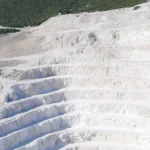
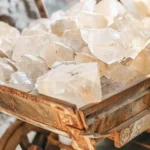
What is limestone? Limestone is a sedimentary rock composed mainly of calcium carbonate (CaCO₃), and its primary mineral is calcite. In Turkish it is called “kalker” or “kireç taşı”. Limestone is the fundamental raw material for cement, lime, aggregate, agriculture and micronized calcium carbonate. In short, limestone is the rock, while calcite is the mineral that forms it.
This guide covers what limestone is, how it forms, the difference between limestone, calcite and marble, its types, where it is found, its chemical formula and its uses. It is written for construction, industrial and agricultural users, students and raw-material buyers.
Quick answer: Limestone is a sedimentary rock made mainly of calcium carbonate (CaCO₃). Its main mineral is calcite. It forms over millions of years from the accumulation of marine organisms’ shells and skeletons (biogenic) or from direct chemical precipitation of CaCO₃. It is used to make cement, lime, aggregate, glass, steel flux and micronized filler. Limestone is the rock, calcite the mineral, and marble is the metamorphosed form of limestone.
What Is Limestone? Basic Definition
Limestone is a sedimentary rock whose composition is largely calcium carbonate (CaCO₃). In pure limestone the CaCO₃ content can exceed 95%; its main mineral is calcite, sometimes with a little aragonite and dolomite. The rock’s colour ranges from white, grey and beige to yellowish or nearly black depending on impurities.
For the industrial properties of micronized calcium carbonate made from limestone, see our micronized calcium carbonate page; for coarse products used as aggregate and flux, see our limestone page.
What Is the Chemical Formula of Limestone?
The main component of limestone is calcium carbonate, with the chemical formula CaCO₃ — the same formula as the calcite mineral that forms it. When limestone is heated (calcination), carbon dioxide is released and calcium oxide (quicklime) remains:
- Limestone: CaCO₃
- Calcination: CaCO₃ → CaO + CO₂ (around 825-900 °C)
- Quicklime: CaO
- Hydrated (slaked) lime: Ca(OH)₂
For a detailed breakdown of lime products (quicklime, hydrated, dolomitic, hydraulic), see our types of lime guide.
How Is Limestone Formed?
Limestone forms in two main ways, both requiring long geological processes:
- Biogenic (organic) formation: the calcium-carbonate shells and skeletons of marine organisms (coral, molluscs, foraminifera, algae) accumulate on the seabed and lithify over millions of years. Most limestone forms this way.
- Chemical precipitation: in waters saturated with calcium carbonate, CaCO₃ precipitates directly. Travertine and some oolitic limestones form this way.
If limestone is later subjected to high temperature and pressure (metamorphism), it turns into marble. Limestone and marble are both chemically CaCO₃; the difference is in crystal structure. For the distinction between calcite and marble powder, see our calcite vs marble powder guide.
Limestone vs Calcite vs Marble
These terms are often confused. The relationship can be summarised as:
| Term | What it is | Formula / Structure |
|---|---|---|
| Limestone (kalker) | Sedimentary rock | Mostly CaCO₃ |
| Calcite | The mineral that forms limestone | CaCO₃ (crystalline) |
| Marble | Metamorphosed limestone | CaCO₃ (recrystallised) |
| Dolomitic limestone | Magnesium-bearing limestone | CaCO₃ + CaMg(CO₃)₂ |
| Chalk | Soft, fine-grained limestone | CaCO₃ |
So limestone is the rock, calcite is the mineral that forms it, and marble is limestone altered by heat and pressure. For the properties of the calcite mineral, see our what is calcite guide; for magnesium-bearing carbonates, our calcite vs dolomite guide.
Types of Limestone
According to their formation environment and composition, the main types of limestone are:
- Reef limestone: fossil-rich limestone formed from coral and shell remains.
- Oolitic limestone: made of small rounded CaCO₃ grains (ooids).
- Chalk: soft, very fine limestone from microscopic organism remains.
- Marl (clayey limestone): limestone with a clay fraction; important for cement.
- Dolomitic limestone: limestone with a high magnesium content.
- Travertine: limestone formed by chemical precipitation from calcium-rich spring waters.
Low-impurity, high-brightness limestone is preferred for industrial filler production. For why brightness matters and how it is measured, see our calcite brightness guide.
Where Is Limestone Found?
Limestone is a very common rock that covers a significant part of the Earth’s land surface. Regions once covered by shallow, warm seas are today rich limestone deposits. Turkey, due to its geology, is extremely rich in limestone and marble, with numerous limestone quarries across the country.
For industrial use, not only the presence but also the purity, brightness and reserve continuity of the limestone matter. Aydın Madencilik operates high-purity limestone reserves from its own licensed sites; see our reserves page.
What Is Limestone Used For?
Limestone is one of industry’s most widely used raw materials. Its main applications:
| Field | Use |
|---|---|
| Cement | Main raw material for clinker |
| Lime production | Quicklime/hydrated lime by calcination |
| Construction / aggregate | Concrete and asphalt aggregate, fill |
| Iron and steel | Slag-forming flux material |
| Glass | CaO source in the glass batch |
| Agriculture | Soil pH adjustment (agricultural lime) |
| Micronized filler | Paint, plastics, paper, construction chemicals |
| Flue-gas treatment | Sulphur removal (desulphurisation) |
Most of these uses rely on the micronized calcium carbonate obtained by grinding and classifying limestone. For the importance of grinding fineness (micron), see our micron size guide; for the heavy vs light calcite distinction, our heavy vs light calcium carbonate guide.
From Limestone to Micronized Calcium Carbonate
Limestone destined for industrial filler use is quarried, crushed, washed, ground and classified by micron size. Micronized calcium carbonate made from high-purity limestone is used as a filler and coating material in paint, plastics, paper and construction chemicals.
Aydın Madencilik sources all of its raw material from its own licensed limestone sites; all micronized grades have CaCO₃ above 98%, Fe₂O₃ below 0.1% and ISO brightness of 93+. For our laboratory and quality-control processes, visit our laboratory page.
Aydın Madencilik Limestone-Based Product Range
| Product group | Range | Typical use |
|---|---|---|
| Micronized calcium carbonate | 3 – 100 µm | Paint, plastics, masterbatch, paper, construction chemicals |
| Coated calcite | 3 – 20 µm | Highly filled polymer and solvent-based systems |
| Calcite stone | Granular / coarse | Feed, agriculture, industrial dosing |
| Limestone | Granular / coarse | Construction, agricultural liming, flux |
Explore the full range on our micronized calcium carbonate page and our limestone page.
Frequently Asked Questions (FAQ)
What is limestone?
Limestone is a sedimentary rock composed mainly of calcium carbonate (CaCO₃), and its main mineral is calcite. It forms over millions of years from the lithification of marine organism remains or from chemical precipitation, and is used to make cement, lime, aggregate, glass and micronized filler.
Is limestone the same as calcite?
Not exactly. Limestone is a rock, while calcite is the mineral that forms it. Limestone is made largely of calcite crystals. Both have the chemical composition calcium carbonate (CaCO₃); the difference is that one is a rock and the other a mineral.
What is the chemical formula of limestone?
The main component of limestone is calcium carbonate, with the formula CaCO₃. When heated it converts to quicklime (CaO) via CaCO₃ → CaO + CO₂, and when slaked with water to hydrated lime (Ca(OH)₂).
How is limestone formed?
Limestone forms mainly in two ways: from the accumulation and lithification of calcium-carbonate shells and skeletons of marine organisms on the seabed (biogenic), or from the direct precipitation of CaCO₃ from calcium-saturated water (chemical). Both processes take millions of years.
Where is limestone found?
Limestone is a very common rock, abundant in regions once covered by shallow seas. Turkey is rich in limestone and marble. For industrial use, the purity, brightness and reserve continuity of the limestone are decisive.
What is limestone used for?
Limestone is used in cement and lime production, as construction aggregate, as a flux in iron and steel, in the glass batch, as a soil conditioner in agriculture, and — when ground and micronized — as a filler in paint, plastics, paper and construction chemicals.
What is the difference between limestone and marble?
Marble is the form limestone takes after metamorphism under high temperature and pressure. Chemically both are calcium carbonate (CaCO₃); the difference is crystal structure. Marble is a recrystallised, denser-textured rock.
What is dolomitic limestone?
Dolomitic limestone is limestone with a higher magnesium (dolomite mineral) content than ordinary limestone. As the magnesium content rises, the rock grades from limestone toward dolomite. This distinction matters industrially in terms of MgO content.
Is limestone a rock or a mineral?
Limestone is a rock. It is made up of one or more minerals — chiefly calcite. Calcite is the mineral, limestone is the rock built from it. Marble is limestone that has been recrystallised by heat and pressure.
How is calcium carbonate obtained from limestone?
High-purity limestone is quarried, crushed, washed and ground in mills, then classified by micron size. The resulting micronized calcium carbonate is used as a filler and coating in paint, plastics, paper and construction chemicals.
Does limestone react with acid?
Yes. Because it is mainly calcite (CaCO₃), limestone fizzes when dilute hydrochloric acid is applied, releasing CO₂. This effervescence is a classic field test used to identify limestone and calcite-rich rocks.
Does Aydın Madencilik produce limestone?
Yes. Aydın Madencilik operates high-purity limestone reserves from its own licensed sites and converts them into micronized calcium carbonate, coated calcite, calcite stone and limestone products. For your application, use our get a quote or contact page.
Related Guides
More technical content on limestone, calcite and lime:
- What Is Calcite? — the mineral that forms limestone
- Types of Lime — quicklime, hydrated, dolomitic, hydraulic
- Calcite vs Marble Powder — the metamorphic form
- Calcite vs Dolomite — dolomitic limestone
- What Is Micron Size? — grinding fineness
- Limestone Products — aggregate and flux
- Micronized Calcium Carbonate — filler products
For Your Limestone and Calcium Carbonate Needs
Properly processed, limestone becomes one of industry’s most valuable raw materials. Aydın Madencilik supplies micronized calcium carbonate and limestone products made from its own high-purity reserves to the paint, plastics, paper, construction and agriculture sectors.
Set the right product and micron range for your application with our technical team: Request a sample | Explore the product range