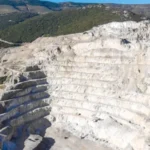
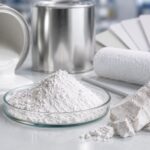
What is barite? It is a question industrial buyers ask when they need a high-density mineral filler. Barite (also spelled baryte) is the mineral barium sulfate (BaSO₄), and it stands out among industrial minerals for its exceptionally high density. For that reason it is often compared with the most common filler, calcite (CaCO₃). The biggest difference between the two is density and chemical behaviour: barite has a density of about 4.5 g/cm³, while calcite is 2.71 g/cm³.
This guide explains what barite is, its chemical and physical properties, its key differences from calcite, its applications from drilling mud to radiation shielding and brake pads, and when barite is preferred over calcite (or vice versa). It is written for filler buyers, plastics and paint R&D teams, and mining engineers.
Quick answer: Barite is the mineral barium sulfate (BaSO₄). Its most distinctive property is high density (~4.5 g/cm³) — almost twice that of calcite (CaCO₃) at about 2.71 g/cm³. Barite is chemically inert, does not react with acid and is insoluble in water; calcite is alkaline and fizzes with acid. Barite is used where weight, sound damping and radiation shielding are required; calcite where economical volume/filling is needed. Barite is more expensive than calcite.
What Is Barite? Basic Definition
Barite is a sulfate mineral with the composition barium sulfate (BaSO₄). Its name comes from the Greek word barys, meaning “heavy”, because it is surprisingly heavy for its size. It usually occurs in white, grey and beige tones, and high-purity deposits can deliver high brightness.
The barium in barite is insoluble in water and the mineral is chemically very stable, so it resists acids, alkalis and solvents. For calcite’s general properties and production, see our what is calcite guide. Barite’s core difference from calcite is both its much higher density and its chemical inertness.
Barite vs Calcite Comparison Table
| Property | Barite | Calcite |
|---|---|---|
| Chemical formula | BaSO₄ | CaCO₃ |
| Mineral class | Sulfate | Carbonate |
| Density | ~4.2 – 4.5 g/cm³ | 2.71 g/cm³ |
| Mohs hardness | 3 – 3.5 | 3 |
| Dilute HCl reaction | No reaction | Rapid effervescence |
| Chemical stability | Inert, acid/alkali resistant | Dissolves in acid, alkaline |
| Water solubility | Practically insoluble | Insoluble (reactive in acid) |
| Radiation absorption | High (high-Z barium) | Low |
| Primary function | Density, weight, shielding | Extender / volume / cost |
| Relative cost | High | Low |
Barite’s Defining Property: High Density
The answer to “what is barite” comes down to one property: density. At about 4.5 g/cm³, barite is almost twice as heavy as calcite. The high atomic number of the barium atom (Z = 56) is the source of both this weight and its radiation-absorbing ability. These two properties let barite serve applications calcite cannot:
- Adding weight: in drilling mud it provides the weight needed to balance well pressure (API drilling barite).
- Sound and vibration damping: its high mass reduces sound transmission in automotive and construction applications.
- Radiation shielding: barium’s high density absorbs X-ray and gamma radiation; it is used in radiology-room concrete and plasters.
Calcite, thanks to its low density, high brightness and low cost, is a volume extender. The two minerals are usually not rivals but complementary options serving different purposes.
Where Are Barite and Calcite Used?
| Application | Preference | Reason |
|---|---|---|
| Oil/gas drilling mud | Barite | High density balances well pressure |
| Radiation-shielding concrete | Barite | Barium’s radiation absorption |
| Brake pads / friction | Barite | Thermal stability and density |
| Automotive sound damping | Barite | Sound damping from high mass |
| High-density / high-gloss paint | Barite | Density and chemical resistance |
| Paint extender (general) | Calcite | Brightness, low oil absorption, cost |
| Plastics / masterbatch (cost) | Calcite | Economical volume, low density |
| Paper filler | Calcite | Optical properties and cost |
On the plastics and masterbatch side, calcite is preferred for low-density, economical filling; see our filler masterbatch guide. For calcite’s extender role in paint, see our calcium carbonate in paint guide.
Barite or Calcite? Decision Criteria
- Do you need high density, weight or shielding? Barite — drilling, radiation, sound damping, friction.
- Do you want economical volume and low weight? Calcite — filling, extender, cost reduction.
- Is there an acidic/aggressive chemical environment? Barite is inert; calcite dissolves in acid.
- Are high brightness and low cost the priority? High-purity calcite.
For calcite compared with other minerals, see our calcite vs dolomite guide and calcite vs marble powder guide.
Barite in Radiation Shielding
One of barite’s most valuable uses is radiation shielding. The high atomic number of the barium atom (Z = 56) and barite’s density of about 4.5 g/cm³ absorb X-ray and gamma radiation effectively. High-density, high-atomic-number (high-Z) materials raise the probability of stopping radiation before it passes through, which is why they are preferred in protective structures. Barite is therefore used as the weighting component of barite concrete and barite plasters — an economical, non-toxic alternative to lead.
The main places barite shielding materials are used include:
- Radiology and oncology rooms: the wall concrete and plaster of X-ray, CT and radiotherapy rooms, to prevent radiation leakage.
- Nuclear facilities: as aggregate/filler in heavy concrete (high-density concrete) for reactor and laboratory structures.
- Industrial radiography: in the protective enclosures of non-destructive testing areas.
Calcite (CaCO₃) cannot be used in these applications because its density of about 2.71 g/cm³ and its low-atomic-number calcium are not sufficient for radiation absorption. Calcite’s real strength is economical volume and brightness; for details, see our what is calcite guide.
API Drilling Barite and the Oil Sector
Barite’s single largest use worldwide is oil and natural gas drilling. Barite is added to the drilling mud pumped into the well as a weighting agent. Its high density raises the specific gravity of the mud, creating a hydrostatic balance against the pressure coming from the formation; this prevents an uncontrolled release from the well (a blowout) and helps keep the borehole wall stable. Barite used for this purpose must meet specific quality standards.
The core requirements for drilling barite are:
- API 13A specification: drilling barite is evaluated against the American Petroleum Institute’s API 13A specification.
- Specific gravity ≥ 4.1-4.2: API-grade barite must meet the minimum specific gravity requirement.
- Controlled particle size and low soluble salts: fineness and purity that do not disturb the mud’s rheology are required.
Calcite is far too light for this application; at 2.71 g/cm³ it cannot deliver the high specific gravity drilling mud requires. Calcite-based products are instead used in economical filling applications such as paint, plastics and paper; for the plastics side, see our filler masterbatch guide.
Aydın Madencilik Calcite Product Range
Aydın Madencilik sources all of its raw material from its own licensed reserves and produces high-purity calcite based products; we do not produce barite. Our range for paint, plastics, paper and construction chemicals consists of micronized calcium carbonate, coated calcite, and calcite and limestone.
| Product group | Range | Typical use |
|---|---|---|
| Micronized calcite (AY 103 – AY 1000) | 3 – 100 µm | Paint, plastics, masterbatch, paper, construction chemicals |
| Coated calcite (K series) | 3 – 20 µm | Highly filled polymer and solvent-based systems |
| Calcite stone | Granular / coarse | Feed, agriculture, industrial dosing |
All micronized grades have CaCO₃ above 98%, Fe₂O₃ below 0.1% and ISO brightness of 93+. Explore the full range on our micronized calcium carbonate page, or visit our laboratory page for an application-specific recommendation.
Frequently Asked Questions (FAQ)
What is barite?
Barite is a sulfate mineral with the composition barium sulfate (BaSO₄). Its most distinctive property is high density (~4.5 g/cm³). It is chemically inert, does not react with acid and is insoluble in water. It is used in drilling mud, radiation shielding, brake pads and high-density filler applications.
What is the difference between barite and calcite?
Barite is barium sulfate (BaSO₄); calcite is calcium carbonate (CaCO₃). The biggest difference is density: barite ~4.5 g/cm³ versus calcite 2.71 g/cm³. Barite is inert and does not react with acid; calcite is alkaline and fizzes with acid. Barite is used for weight/shielding, calcite for economical filling.
Why is barite so heavy?
The barium atom in barite has a high atomic number (Z = 56) and high atomic mass. This gives the mineral its high density of about 4.5 g/cm³ and is also the source of its radiation-absorbing ability.
Why is barite used for radiation shielding?
Barium’s high density and high atomic number absorb X-ray and gamma radiation effectively. Barite is therefore used as the weighting component of radiation-protective concrete and plasters in radiology rooms and nuclear facilities. Calcite does not have sufficient density for this purpose.
Does barite react with acid?
No. Barite is chemically inert and does not react with dilute acid. Calcite, on the other hand, fizzes rapidly with dilute hydrochloric acid. This is a practical way to tell the two minerals apart.
Is barite or calcite more expensive?
Barite is usually more expensive than calcite. Barite reserves are more limited and it offers a specialised function such as high density. Calcite is an economically produced volume/cost filler from widespread, high-grade reserves.
Does Aydın Madencilik produce barite?
No. Aydın Madencilik produces high-purity calcite based products: micronized calcium carbonate (3-100 µm), coated calcite, calcite stone and limestone. Our team can assess the right filler for your application; use our get a quote or contact page.
Is barite toxic?
Barite in the form of barium sulfate (BaSO₄) is inert and insoluble in water, so it is not hazardous the way soluble barium salts are. Because it does not dissolve, it is not absorbed by the body; in fact it is swallowed as a contrast agent for gastrointestinal X-rays in medicine. As with any mineral dust, however, occupational safety measures against respirable dust should still be taken.
Is barite soluble in water?
No. Barite is practically insoluble in water and chemically very stable. This insolubility is the main reason it is both environmentally and biologically safe and usable without issue in drilling mud and chemically aggressive environments.
Are barite and barium the same?
No. Barium (Ba) is a chemical element in the periodic table. Barite is the natural mineral this element forms with sulfate, that is, barium sulfate (BaSO₄). In short, barium is the element, while barite is the mineral that contains barium.
What does barite do in brake pads?
In brake pads and friction materials, barite is used as a filler. Thanks to its thermal stability, density and inertness, it withstands the high temperatures generated during braking and balances the pad’s mass and friction behaviour. This makes it a common ingredient in organic and semi-metallic brake pad formulations.
Where is barite found?
Barite is found in sedimentary and hydrothermal deposits, often as vein fillings. The major producing countries include China, India, Morocco, the USA and Turkey. Turkey has barite deposits in several regions; however, Aydın Madencilik produces high-purity calcite, not barite.
Related Guides
More technical content on calcite and mineral fillers:
- What Is Calcite? — complete guide to calcium carbonate
- Calcite vs Talc — industrial filler comparison
- Calcite vs Kaolin — another white filler mineral
- Calcite vs Dolomite — magnesium-bearing carbonate comparison
- Calcite vs Marble Powder — same chemistry, different origin
- Filler Masterbatch — calcite in plastics
- Calcium Carbonate in Paint — extender pigment and TiO₂ saving
Choose the Right Mineral Filler for Your Application
Barite and calcite serve different needs: barite provides density and shielding, calcite provides economical volume and brightness. Identifying which property is critical in your application is the first step to the right mineral choice.
The Aydın Madencilik technical team will help you select the right calcite grade and micron range for your application: Request a sample | Explore the product range