Calcite brightness is one of the most important optical parameters defining the quality of calcium carbonate as a filler and pigment extender. Brightness is the measure of how much blue light a powder reflects, usually expressed for calcite (CaCO₃) as ISO brightness (%). High brightness means better hiding power and titanium dioxide efficiency in paint, optical quality in paper, and colour cleanliness in plastics.
This guide covers what calcite brightness is, the difference between brightness, whiteness and yellowness, the L*a*b* colour system, the impurities that lower brightness, how it is measured and why it is critical. It is written for the R&D, quality-control and procurement teams of paint, paper and plastics manufacturers.
Quick answer: Calcite brightness is the reflectance of blue light (457 nm) by the powder, measured as ISO brightness (R457) in %. High-purity calcite can deliver ISO 90-97 brightness. The main factors that lower brightness are iron oxide (Fe₂O₃), manganese and organic/graphite impurities. Brightness is a single number, while colour is defined three-dimensionally by L*a*b*; yellowness (+b*) in particular is undesirable in a white filler. Brightness is measured with a spectrophotometer.
What Is Calcite Brightness?
Brightness is the measure of a surface’s reflectance at a specific wavelength (usually 457 nm blue light). Measured according to ISO 2470, this value is called ISO brightness or R457 and is expressed between 0% (perfect black) and 100% (perfect white reference). For calcite’s general properties, see our what is calcite guide.
Two concepts are often confused with brightness:
- Brightness: reflectance at a single (blue) wavelength. The most common quality metric for filler minerals.
- Whiteness: a broader concept based on the entire visible spectrum that describes the eye’s perception of white (e.g. CIE whiteness).
- Yellowness index: the degree to which the material tends toward yellow; an undesirable property in a white filler.
The L*a*b* Colour System and Calcite
While brightness gives a single number, the colour of a calcite powder is fully defined on three axes by the CIE L*a*b* system:
| Axis | Meaning | Target in calcite |
|---|---|---|
| L* | Lightness (0 black – 100 white) | As high as possible (→100) |
| a* | Green (–) / red (+) | Close to 0 (neutral) |
| b* | Blue (–) / yellow (+) | Low +b* (yellowness undesirable) |
In a high-quality filler calcite, L* should be high while a* and b* are close to zero. A rising b* value (yellowness) in particular usually signals iron or organic impurities and causes colour deviation in the white end product.
What Lowers Calcite Brightness?
Pure calcium carbonate is theoretically very white; brightness loss almost always comes from impurities:
- Iron oxide (Fe₂O₃): the most important impurity lowering brightness and adding a yellow/red tone. In quality filler calcite Fe₂O₃ is usually below 0.1%.
- Manganese (Mn) and other transition metals: even small amounts can cause colour deviation.
- Graphite / organic matter: causes greying and brightness loss.
- Clay and silicate impurities: lower brightness and increase abrasiveness.
Brightness is therefore an indirect indicator of purity: high brightness means low iron and low impurities. Reserve quality and the grinding/classification process directly affect brightness. Particle fineness also influences perceived brightness; see our micron size guide.
How Is Calcite Brightness Measured?
Brightness is measured in the laboratory with a spectrophotometer (e.g. Elrepho-type instruments). The powder sample is pressed to a standard density and the instrument reads the reflectance at 457 nm (ISO brightness) together with L*a*b* values, calibrated against a standard white reference.
At Aydın Madencilik, brightness is measured as a routine quality-control parameter for every batch. See our processes on our laboratory page.
Why Does Brightness Matter in Each Application?
| Industry | Importance of brightness |
|---|---|
| Paint and coatings | Supports hiding power and TiO₂ efficiency; ensures colour cleanliness |
| Paper | Increases the paper’s optical brightness and print quality |
| Plastics and masterbatch | Critical for colour cleanliness and pigment efficiency |
| Construction chemicals | Appearance in white joint fillers, putties and renders |
| PVC profile | Colour stability in white profiles |
For how high-brightness calcite as an extender pigment contributes to TiO₂ saving in paint, see our calcium carbonate in paint guide. Brightness is also an advantage that sets calcite apart from other minerals; that comparison is covered in our calcite vs dolomite guide.
When Evaluating a Brightness Value
- Which standard? ISO brightness (R457) and CIE whiteness give different numbers; use the same standard when comparing.
- Ask for L*a*b* values: brightness alone is not enough; yellowness (+b*) should be low.
- Check the Fe₂O₃ value: low iron is the best indicator of high and stable brightness.
Brightness and Titanium Dioxide (TiO₂) Efficiency
The pigment that actually delivers hiding power in a paint formulation is titanium dioxide (TiO₂), yet TiO₂ is the most expensive item in the recipe. This is where high-brightness calcite steps in as an extender pigment: its blocky particles slot in between the TiO₂ particles, holding them at optimum spacing, preventing them from crowding and losing hiding efficiency, and supporting light scattering. As a result the formulator can reach the same opacity with less TiO₂. For this effect to work, the calcite’s own brightness must be high; a low-brightness filler contaminates the paint colour and makes any TiO₂ saving meaningless. Brightness is therefore the most critical parameter of an extender calcite.
- Particle spacing effect: calcite particles separate the TiO₂ particles, optimising light scattering and hiding power.
- Cost reduction: with high-brightness calcite the TiO₂ level can be safely reduced, lowering formulation cost.
- Colour cleanliness: the higher the calcite brightness, the cleaner the final paint tone stays.
For more on calcite’s extender pigment role and TiO₂ saving in paint, see our calcium carbonate in paint guide.
Preserving Brightness: Reserve Quality, Grinding and Iron Control
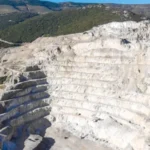
High brightness is not created afterwards in the laboratory; above all it starts with a low-iron, high-purity reserve. In a correctly chosen calcite deposit the Fe₂O₃ content is low, so the raw material already has high brightness from the outset. That potential, however, must be preserved throughout production: controlled grinding and air classification deliver a fine particle distribution, while any metal (iron) contamination from the grinding equipment must be carefully avoided. Otherwise process-borne Fe₂O₃ irreversibly lowers the reserve’s brightness and raises the +b* (yellowness) value in the L*a*b* system. Brightness is thus the joint result of both reserve quality and production discipline.
- Reserve selection: pure calcite veins with low Fe₂O₃ and low organic content are the foundation of high brightness.
- Controlled grinding and classification: precise classification and the right grinding media preserve brightness.
- Preventing metal contamination: iron from worn grinding parts is the most insidious source of brightness loss.
For the effect of particle fineness on brightness, see our micron size guide, and for our routine brightness and L*a*b* measurements, our laboratory page.
Aydın Madencilik Calcite Product Range
Aydın Madencilik sources all of its raw material from its own licensed reserves and produces high-brightness calcite. Thanks to our high-purity reserves, our products have ISO brightness of 93+ and Fe₂O₃ below 0.1%.
| Product group | Range | Typical brightness |
|---|---|---|
| Micronized calcite (AY 103 – AY 1000) | 3 – 100 µm | ISO 93+ |
| Coated calcite (K series) | 3 – 20 µm | ISO 93+ |
| Calcite stone | Granular / coarse | High |
All micronized grades have CaCO₃ above 98% and Fe₂O₃ below 0.1%. Explore the full range on our micronized calcium carbonate page, or visit our laboratory page for brightness and L*a*b* values.
Frequently Asked Questions (FAQ)
What is calcite brightness?
Calcite brightness is the reflectance of blue light (457 nm) by the powder, measured according to ISO 2470 as ISO brightness (R457) in %. High-purity calcite can deliver ISO 90-97 brightness. Brightness indicates the optical quality and, indirectly, the purity of the calcite.
Are brightness and whiteness the same?
No. Brightness is reflectance at a single (blue) wavelength. Whiteness is a broader concept based on the whole visible spectrum that describes the eye’s perception of white (e.g. CIE whiteness). Use the same standard when comparing.
What lowers calcite brightness?
The main factor is iron oxide (Fe₂O₃); manganese, graphite/organic matter and clay-silicate impurities also lower brightness and add a yellow/grey tone. High brightness therefore means low iron and high purity.
Why are L*a*b* values requested?
Brightness alone does not give the full colour profile. L* defines lightness, a* the green-red axis and b* the blue-yellow axis. In a white filler, L* should be high while a* and b* are close to zero; high +b* (yellowness) is particularly undesirable.
How is calcite brightness measured?
Brightness is measured in the laboratory with a spectrophotometer. The powder is pressed to a standard density and the instrument reads the 457 nm reflectance (ISO brightness) and L*a*b* values against a standard white reference.
Why does brightness matter in paint?
High-brightness calcite supports colour cleanliness and hiding power in paint and helps use expensive titanium dioxide more efficiently. A low-brightness filler can contaminate the final paint colour.
What is the brightness of Aydın Madencilik calcite?
Aydın Madencilik micronized calcite products typically have ISO brightness of 93+ and Fe₂O₃ below 0.1%. Our team can help you assess the brightness and L*a*b* values suited to your application; use our get a quote or contact page.
What ISO brightness should calcite have?
Filler-grade calcites commonly have ISO brightness in the 90-97 range; the threshold depends on the application. Paint, paper and white plastics, where colour cleanliness is critical, call for higher brightness. Aydın Madencilik micronized calcite products typically have ISO brightness of 93+.
What is R457?
R457 is the powder’s reflectance of blue light at a 457 nm wavelength, and it is exactly the ISO brightness measured according to ISO 2470. The “R” stands for reflectance and “457” for the blue-light wavelength at which the measurement is taken. So for calcite, “ISO brightness” and “R457” describe the same value.
Pure calcium carbonate is theoretically very white; brightness loss almost always comes from impurities. High brightness therefore means, indirectly, low iron (Fe₂O₃) and low impurity content. Brightness is a practical, fast indicator of a calcite’s purity.
Why does calcite look yellow?
The main cause of yellowing is iron oxide (Fe₂O₃); organic matter and some transition metals also add a yellow tone. These impurities raise the +b* (yellowness) value in the L*a*b* system. A low-iron reserve and production that prevents metal contamination minimise yellowing.
How is brightness improved?
Brightness is improved first by selecting a purer, lower-iron reserve. On the production side, finer and controlled grinding, precise classification and preventing iron contamination from the grinding equipment raise brightness and keep it stable. Where needed, magnetic separation can remove iron-bearing particles.
Related Guides
More technical content on calcite brightness and quality parameters:
- What Is Calcite? — complete guide to calcium carbonate
- Calcium Carbonate in Paint — extender pigment and TiO₂ saving
- Calcite Oil Absorption — resin demand and cost
- Micron Size — particle size and distribution
- Calcite vs Dolomite — brightness and purity comparison
- Calcium Carbonate in Paper — optical brightness and filler
- Laboratory — brightness and L*a*b* measurement
Choose Calcite with the Right Brightness for Your Application
Calcite brightness is a quality parameter to be evaluated together with purity, iron content and the L*a*b* colour profile. Calcite with the right brightness directly improves the colour quality and pigment efficiency of your end product.
The Aydın Madencilik technical team will help you select the right-brightness calcite grade and micron range for your application: Request a sample | Explore the product range