Calcite is one of the most abundant and economically important minerals in industrial production. With the simple chemical formula CaCO₃ — calcium carbonate — it is the raw material behind everything from paper and paint to plastics, cable, glass, ceramics, agriculture, construction and pharmaceuticals. Yet despite its simplicity, calcite has a rich geology, a wide range of grades, and a real impact on the performance and cost of every product that uses it.
This complete guide answers “what is calcite?” from the technical, geological and industrial perspectives. We cover its mineralogy, how it forms, where the major global and Turkish reserves are located, how a calcite quarry is converted into micronised industrial powder, where it is used, and how to evaluate quality when sourcing for B2B applications.
Quick definition: Calcite is a natural CaCO₃ (calcium carbonate) mineral with a trigonal crystal system. It is the principal mineral of limestone and marble, has a Mohs hardness of 3 and a density of 2.71 g/cm³. Industrial-grade micronised calcite (GCC) is used as a filler and pigment across paper, paint, plastics, cable, masterbatch and many other B2B sectors.
The Calcite Mineral: Definition and Chemical Structure
Calcite is a carbonate mineral with the formula CaCO₃. It is the most stable polymorph of calcium carbonate at standard temperature and pressure — the others being aragonite and vaterite, which are less common in nature.
In its pure form calcite is colourless or white, with vitreous lustre and transparent to translucent appearance. Trace impurities of iron, manganese, magnesium and trace organics can colour it pale yellow, brown, pink, green or blue.
Physical and Chemical Properties of Calcite
| Property | Value |
|---|---|
| Chemical formula | CaCO₃ |
| Crystal system | Trigonal (rhombohedral) |
| Common crystal habits | Rhombohedral, scalenohedral, prismatic |
| Mohs hardness | 3 |
| Density | 2.71 g/cm³ |
| Cleavage | Perfect on three directions |
| Streak | White |
| Lustre | Vitreous |
| Refractive index | 1.486 – 1.658 (strong birefringence) |
| Decomposition temperature | ~825 °C (CaCO₃ → CaO + CO₂) |
| Solubility | Soluble in dilute acids (HCl reaction releases CO₂) |
The reaction with dilute acid is the classic field test: a drop of dilute HCl on a calcite sample produces visible effervescence (CO₂ bubbles). This reaction is the basis for many laboratory purity assays.
How Does Calcite Form? Geological Origin
Calcite forms in three main geological settings:
- Sedimentary: precipitation from seawater or freshwater rich in dissolved calcium and carbonate ions — the origin of limestone.
- Biogenic: from skeletal remains of marine organisms (corals, molluscs, foraminifera) — the source of many limestone reserves.
- Metamorphic and hydrothermal: recrystallisation of limestone under heat and pressure produces marble; hydrothermal solutions deposit calcite as vein-fill in fractures.
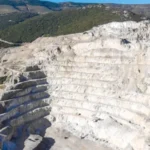
Industrial calcite reserves form over millions of years through these processes. The most prized B2B reserves are those with high CaCO₃ purity (above 97 %), low iron and silica contamination, and good block structure for quarrying.
Turkish Calcite Reserves and Their Importance
Türkiye holds some of the world’s most strategically important calcite reserves. The country sits on extensive carbonate-rock formations and supplies a significant share of global B2B GCC consumption.
Key Turkish calcite regions:
- Muğla (Yatağan–Kavaklıdere): the most renowned high-purity calcite belt — ISO whiteness above 96, CaCO₃ above 98 %.
- Niğde: high-purity reserves serving paper and paint applications.
- Burdur, Adıyaman, Eskişehir: mid-range reserves serving construction, agriculture and bulk plastics.
The strategic importance of these reserves is reinforced by Türkiye’s geographic position — a 3–5 day sea route via Marmara ports to European markets and direct sea access to MENA.
The Calcite Production Process: Crushing, Grinding and Classification
From quarry rock to bagged industrial powder, calcite passes through a well-defined production chain:
- Extraction: high-purity rock is selectively extracted from the quarry face.
- Primary crushing: jaw or impact crushers reduce blocks to centimetre-scale aggregate.
- Secondary crushing: cone or hammer crushers further reduce particle size.
- Drying: rotary dryers eliminate moisture before fine grinding.
- Micronisation: classifier mills (Hosokawa Alpine) reduce the material to micronised powder.
- Air classification: oversize particles are separated and recirculated through the mill to deliver a narrow PSD.
- QC and packaging: each batch is analysed for d50, d97, whiteness, CaCO₃ purity, moisture and trace impurities, then bagged or shipped in big-bags with a Certificate of Analysis.
The classifier-mill stage is the technology that distinguishes premium GCC producers. Modern plants use precise air-classification to deliver narrow PSD and consistent batch-to-batch performance.
What Is Micronised Calcium Carbonate (GCC)?
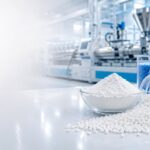
“Micronised calcium carbonate” or GCC (Ground Calcium Carbonate) is the industrial form of calcite — micronised down to a specific d50 (typically 1 to 50 µm) with controlled PSD.
GCC is preferred globally over PCC (Precipitated Calcium Carbonate) for the vast majority of industrial uses because GCC is:
- 2–4× less expensive than PCC
- Far lower in energy and CO₂ footprint
- Available in a wider range of particle sizes
- Just as suitable for paper, paint, plastics, cable, masterbatch and construction
For a detailed GCC vs PCC comparison see our GCC vs PCC guide.
Where Calcite Is Used: Industrial Applications
Micronised calcite is used across more than ten industries. The most important B2B applications:
- Paper: wet-end filler and surface coating, raising brightness and reducing cellulose use.
- Paint: opacifier, brightness booster, rheology modifier and cost optimiser.
- Plastics: filler in PP, PE, PVC, ABS — natural or stearic-acid coated.
- Cable: mechanical support in HFFR halogen-free compounds, alongside ATH/MDH.
- Masterbatch: high-loading filler and colour masterbatch base.
- Rubber: reinforcing filler in natural and synthetic rubber compounds.
- Construction chemicals: tile adhesives, grouts, mortars, ETICS systems.
- Ceramic and glass: source of CaO; flux in glass-making.
- Automotive: filler in plastic and rubber parts, primers and sealants.
- Agriculture and livestock: soil pH correction (liming), animal-feed calcium supplement.
Aydın Madencilik supplies micronised calcite to all of these 10 industries from its Bursa Gemlik facility.
Difference Between Calcite and Limestone
Calcite and limestone are related but not identical:
- Calcite is a single mineral — pure CaCO₃ in crystalline form.
- Limestone is a sedimentary rock that consists predominantly of calcite (sometimes accompanied by dolomite, quartz and clay impurities). Its purity is typically lower than refined calcite.
- Marble is the metamorphic version of limestone — recrystallised calcite under heat and pressure.
In B2B procurement: high-purity calcite reserves are the source of premium micronised GCC; limestone of intermediate purity is used for cement, aggregates and bulk lime production.
Parameters That Determine Calcite Quality
For B2B procurement, the following parameters matter most:
- CaCO₃ purity — above 97 % is industrial grade; above 98 % is premium.
- ISO whiteness — 90 – 97 typical range; above 95 considered premium.
- Particle size distribution (d10, d50, d90, d97) — narrow PSD is preferred.
- Trace contaminants — Fe₂O₃ below 0.1 %, halogens below 100 ppm, SO₃ residuals low.
- Moisture — below 0.3 % for plastic compounding and cable applications.
- Abrasiveness — measured by Einlehner or similar tests; matters for paper and high-throughput plastics extrusion.
What to Watch When Buying Calcite
- Source reserves — wholly-owned, licensed and high-purity reserves rather than third-party purchased material.
- Production technology — Hosokawa Alpine classifier-mill technology or equivalent.
- Laboratory capability — in-house analytics for PSD (ISO 13320), brightness (ISO 2470-1), purity (titration), heavy metals, moisture and abrasiveness.
- Certifications — ISO 9001, ISO 14001, ISO 45001, REACH dossier.
- Batch-level CoA — every shipment with full analytical report.
- Logistics — port access, container handling, 3–5 day European delivery capability.
- Technical support — formulation help and pilot-scale validation.
- Reference customers — proven track record in your industry.
Operating since 1999 from its 15,000 m² Bursa Gemlik facility, Aydın Madencilik meets all of these criteria. For more on our credentials, see About Us.
Frequently Asked Questions
Is calcite the same as calcium carbonate?
Yes — chemically. Calcite is the natural mineral form of calcium carbonate (CaCO₃). The terms are often used interchangeably, although “calcium carbonate” can also refer to synthetic PCC. In B2B contexts, “calcite” usually implies natural micronised GCC.
Is calcite a precious mineral?
No. Calcite is one of the most abundant minerals on Earth. Its industrial value lies in its purity, particle size control and downstream applications — not in rarity. Optical-grade calcite crystals (used in polarising prisms) are a specialty niche.
Why is Turkish calcite considered high quality?
Türkiye sits on extensive carbonate-rock formations, including reserves of exceptional purity (above 98 % CaCO₃) and high natural whiteness. The Muğla Yatağan–Kavaklıdere belt is internationally recognised for premium-grade industrial calcite. Combined with sea-port logistics to Europe and MENA, Turkish calcite has a strong cost-quality balance.
What is the difference between calcite and dolomite?
Calcite is pure CaCO₃. Dolomite is CaMg(CO₃)₂ — a calcium-magnesium carbonate. Dolomite has higher hardness, lower whiteness and different industrial properties. In micronised filler applications calcite is generally preferred for whiteness and lower abrasiveness.
Can calcite be recycled?
Yes — micronised calcite in many products (paper, certain plastic compounds, paint) can be recovered through standard recycling streams. Calcite is also recyclable through cement production: end-of-life CaCO₃-bearing materials can be re-introduced into clinker feedstocks. It is a low-impact mineral with a natural place in circular-economy product design.
So, What Is Calcite — Really?
Calcite is the natural, abundant, industrially indispensable mineral that quietly enables modern materials. From the brightness of the paper in your hands to the strength of a kilometre of underground cable, calcite is in the formulation — engineered into a precise micron, purity and PSD by a supply chain that runs from quarry to classifier mill to your warehouse.
To request samples, technical data sheets and pilot validation: Request a sample | Calcite stone | Calcium carbonate (GCC) range