The GCC vs PCC question is one of the most frequent in industrial calcium carbonate procurement. Both materials share the same chemical formula (CaCO₃), yet differ fundamentally in production method, particle shape, particle size distribution, purity, bulk density, carbon footprint, cost — and the industries that prefer each.
This comparison guide explains how GCC and PCC are made, sets out their key technical differences side by side, and provides a sector-by-sector decision framework. The content is written for plastics, paint, paper, masterbatch, rubber and pharmaceutical buyers across Europe and MENA.
Quick definition: GCC (Ground Calcium Carbonate) is produced by mechanical micronisation of natural calcite rock. PCC (Precipitated Calcium Carbonate) is produced through controlled chemical precipitation, typically by reacting CaO with CO₂. GCC dominates global B2B use in plastics, paint, paper filler, masterbatch and construction — PCC is preferred in premium coatings, pharma and a subset of specialty plastics where ultra-narrow PSD or specific crystal habit is required.
What Is GCC (Ground Calcium Carbonate)?
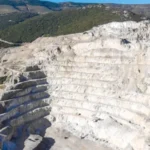
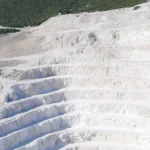
GCC is produced from natural calcite or marble rock. Run-of-mine rock from a licensed quarry is crushed, milled and classified into a micronised powder with a controlled particle-size distribution.
Production stages:
- Quarry extraction (high-purity calcite reserves)
- Primary and secondary crushing
- Drying
- Classifier mill micronisation (e.g. Hosokawa Alpine)
- Pneumatic classification of oversize particles
- Bagging and shipment with batch-level CoA
GCC has an irregular, cubic-to-rhombic particle shape inherited from the natural calcite crystal lattice. Particle sizes typically span 0.5 to 100 µm, depending on grade. ISO whiteness ranges from 90 to 97.
What Is PCC (Precipitated Calcium Carbonate)?
PCC is a synthetic calcium carbonate produced through chemical precipitation. The standard route is the lime-soda or carbonation process:
- Limestone is calcined to produce CaO (quicklime) and CO₂.
- CaO is slaked with water to form Ca(OH)₂ (slaked lime).
- CO₂ is bubbled through the Ca(OH)₂ slurry under controlled temperature and agitation.
- CaCO₃ precipitates as fine crystals; particle shape and size are controlled by process conditions.
- The slurry is filtered, dried, milled and packaged.
PCC has a regular crystalline particle shape — scalenohedral, rhombohedral, prismatic or aragonitic — selectable by adjusting precipitation conditions. Particle sizes are typically 0.1 to 3 µm with a very narrow PSD. ISO whiteness can reach 95 – 98.
GCC vs PCC Comparison Table
| Property | GCC (Ground) | PCC (Precipitated) |
|---|---|---|
| Source | Natural calcite/marble rock | Synthetic chemical precipitation |
| Production method | Mechanical grinding + classification | CaO + CO₂ in controlled reactor |
| Particle shape | Irregular, cubic/rhombic | Regular: scalenohedral / rhombohedral / aragonitic |
| Particle size range | 0.5 – 100 µm | 0.1 – 3 µm |
| PSD width | Medium | Very narrow |
| Bulk density | Higher (~1.0 g/cm³) | Lower (~0.4 g/cm³) |
| Surface area | Lower (~1–10 m²/g) | Higher (~10–50 m²/g) |
| ISO whiteness | 90 – 97 | 95 – 98 |
| Purity (CaCO₃) | Above 97 % | Above 98 % |
| Energy intensity | Low | Very high (calcination) |
| Carbon footprint | Low | High |
| Cost (per tonne) | Lower | 2–4× higher |
Particle Size and Crystal Habit Differences
The crystalline structure of PCC enables formulators to choose a specific particle morphology for their target application:
- Scalenohedral PCC — high surface area, excellent in coated paper and high-opacity paint
- Rhombohedral PCC — balanced mechanical reinforcement in pharmaceuticals and food
- Aragonitic PCC — needle-like crystals, reinforces polymers and elastomers
GCC has a single irregular morphology determined by the natural crystal lattice. For most industrial applications this is fully sufficient — and the cost advantage is significant. Modern classifier-mill GCC delivers narrow PSD that rivals many PCC grades in performance.
Bulk Density Difference
Bulk density (apparent density) reflects how tightly the particles pack:
- GCC: typically 1.0 g/cm³
- PCC: typically 0.4 g/cm³
The implication: 1 tonne of PCC occupies roughly 2.5× the volume of 1 tonne of GCC. This affects shipping, storage and silo design — important for procurement planning. In compound formulations, the same weight of PCC contributes more bulk volume than GCC, allowing for higher virtual filler loading without sacrificing flow.
GCC vs PCC by Industry Sector
| Sector | Primary Choice | Reason |
|---|---|---|
| Paper filler (wet-end) | GCC | Cost-effective, sufficient brightness |
| Paper coating (premium top-coat) | PCC | Higher brightness, gloss, ink hold-out |
| Decorative paint | GCC | Whitening + cost optimisation |
| Industrial coatings | GCC | Filler bulk, anti-corrosion priming |
| Premium architectural paint (matte) | PCC | Matte finish, controlled rheology |
| Plastics (PP, PE, PVC compound) | GCC | High loading + processing economics |
| Engineering plastics (PA, PBT) | PCC (limited) | Reinforcement at low loading |
| HFFR cable compounds | GCC | Mechanical balance with ATH/MDH |
| Masterbatch (filler + colour) | GCC | High loading, low cost |
| Rubber (NR, NBR, SBR) | GCC | Reinforcement, low cost |
| Pharmaceuticals (antacid, calcium supplements) | PCC | Pharma-grade purity, controlled shape |
| Food and feed additives | PCC (often) | Food-contact purity |
| Construction chemicals | GCC | Bulk filler economics |
Cost Comparison
PCC typically costs 2–4× more per tonne than GCC. The premium is driven by:
- Energy-intensive limestone calcination (decomposition at ~900 °C)
- Wet chemical processing requiring controlled reactors
- Lower bulk density — higher shipping cost per unit weight
- Smaller global production capacity
For premium applications where the value of brightness or specific crystal habit exceeds the cost premium, PCC is the right choice. For the rest of the industrial spectrum, GCC delivers a far better economic profile.
Environmental Impact
Sustainability is increasingly part of supplier selection. The two materials compare as follows:
- GCC — low energy, low water consumption, low CO₂ footprint. Recyclable mineral, ISO 14001 certifiable supply chain.
- PCC — calcination releases CO₂ from limestone and burns fossil fuels for the kiln; the wet process requires water and chemical neutralisation.
Some modern PCC plants are integrated with industrial CO₂ capture (e.g. flue-gas carbonation) to offset emissions. For most European customers with active carbon-reduction targets, GCC remains the lower-impact choice.
Which to Choose? Decision Framework
Three questions decide the GCC vs PCC choice:
- Does the application require specific crystal habit? If yes (scalenohedral, aragonitic, prismatic) — choose PCC.
- Does the application require ISO brightness above 96? If yes — consider PCC. Otherwise GCC’s 90–97 range is sufficient.
- Is bulk cost a dominant factor? If yes — GCC delivers 2–4× better cost economics.
For 90 %+ of B2B industrial calcium carbonate consumption, GCC is the right choice. PCC’s premium is justified only in a specific subset of paper coating, paint, pharma and engineering plastics.
Aydın Madencilik GCC Product Range
Aydın Madencilik specialises in natural micronised GCC produced on Hosokawa Alpine classifier mills at its 15,000 m² covered facility in Bursa Gemlik. The product family covers the full GCC micron spectrum:
- AY 103 (3 µm) — premium paper coating, fine paint, polymer top-coats
- AY 106 (6 µm) — paper wet-end filler, plastics, masterbatch
- AY 108 (8 µm) — HFFR cable, plastics, masterbatch
- AY 210 (10 µm) — general plastics, rubber, paint
- AY 215 (15 µm) — economical HFFR, high-loading compounds
For Europe-bound shipments via Gemlik Port: 3–5 day delivery to Germany, Italy, the Netherlands, the Czech Republic, Poland and the Nordics. See full product specifications.
Frequently Asked Questions
Are GCC and PCC chemically the same?
Chemically yes — both are CaCO₃. The differences are structural and morphological: production method, particle shape, particle size, PSD, surface area, bulk density and trace impurities. These structural differences drive different industrial performance.
Can GCC fully replace PCC?
In most industrial applications yes — modern classifier-mill GCC delivers narrow PSD and high whiteness that rival many PCC grades. For premium coated paper top-coats, certain engineered plastics and pharma applications where specific crystal habits are required, PCC remains the choice.
Which has higher purity, GCC or PCC?
PCC typically reaches purity above 98 % because its synthesis route excludes most natural impurities. Premium GCC from high-quality calcite reserves easily exceeds 97 % and is often sold at 98 %+ — close to PCC purity at a fraction of the cost.
Why is PCC so much more expensive?
Because it is energy intensive to produce. Calcining limestone to CaO consumes large amounts of fuel at ~900 °C, and the wet precipitation step requires water and controlled chemical reactors. The low bulk density also raises shipping cost per tonne.
Which is the more sustainable option?
GCC. Its production has a much lower energy footprint, lower water consumption and lower CO₂ emissions than PCC. For sustainability-driven mills targeting Scope 1 and Scope 3 reductions, GCC from an ISO 14001 certified supplier is the lower-impact choice.
Does Aydın Madencilik produce PCC?
No — Aydın Madencilik specialises exclusively in natural GCC. Our position is that for the overwhelming majority of B2B applications, narrow-PSD micronised GCC is the right balance of performance, cost and sustainability. We supply PCC consultancy and sourcing referrals when customers genuinely need it.
Choose the Right Calcium Carbonate for Your Industry
The GCC vs PCC decision is not a question of “good vs better” — both are excellent within their domains. The real question is: does your formulation truly require what PCC offers, or can a modern narrow-PSD GCC deliver the same result at a far lower cost and carbon footprint?
To discuss grade selection or request a sample: Request a sample | Browse industry pages